MATHEMATICS S4 UNIT 9: Differentiation of Polynomials, Rational and Irrational Functions, and their Applications.

About Course

Course Unit 9: “Differentiation of polynomials, rational and irrational functions, and their applications” is a cornerstone of introductory calculus. It moves beyond the conceptual understanding of limits to the practical mechanics of finding derivatives and using them to solve real-world problems.

Here’s a detailed overview of what this unit typically covers:
 

Show More

What Will You Learn?

  • At the end of a course unit titled "Differentiation of polynomials, rational and irrational functions, and their applications," students are expected to have a comprehensive understanding of differential calculus as it applies to these specific function types. They should be able to:
  • I. Master the Fundamentals of Differentiation:
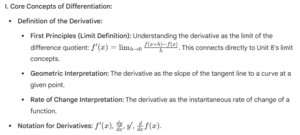
  • Define the Derivative: Articulate the formal definition of the derivative as the limit of a difference quotient (first principles) and understand its geometric interpretation as the slope of a tangent line and its physical interpretation as an instantaneous rate of change.
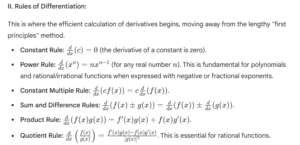
  • Apply Differentiation Rules: Fluently and accurately apply the fundamental rules of differentiation:
  • Constant Rule
  • Power Rule
  • Constant Multiple Rule
  • Sum and Difference Rules
  • Product Rule
  • Quotient Rule
  • Chain Rule (crucial for composite irrational functions)
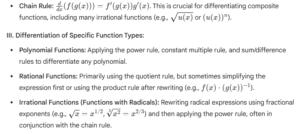
  • Differentiate Various Function Types:
  • Polynomials: Differentiate any polynomial function efficiently using the power rule and sum/difference rules.
  • Rational Functions: Differentiate rational functions using the quotient rule, and recognize alternative methods (like rewriting and using the product rule or power rule).
  • Irrational Functions (Radicals): Differentiate functions involving radicals by converting them to fractional exponents and applying the power rule, often in conjunction with the chain rule.
  • Calculate Higher-Order Derivatives: Find second, third, and higher derivatives of functions.
  • II. Understand and Apply Derivatives to Analyze Function Behavior:
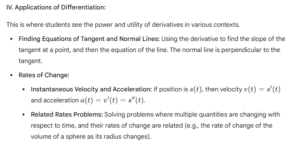
  • Tangent and Normal Lines: Find the equation of the tangent line and the normal line to a curve at a given point.
  • Rates of Change:
  • Interpret the derivative as a rate of change in various contexts (e.g., velocity and acceleration as derivatives of position).
  • Solve related rates problems, where rates of change of two or more quantities are related by an equation.
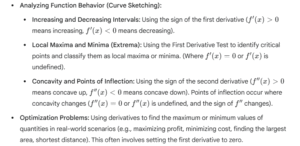
  • Curve Sketching and Analysis:
  • Determine intervals where a function is increasing or decreasing by analyzing the sign of the first derivative.
  • Identify local maxima and minima (extrema) using the First Derivative Test.
  • Determine intervals of concavity (concave up or concave down) by analyzing the sign of the second derivative.
  • Locate points of inflection where the concavity of a function changes.
  • Use all this information to accurately sketch the graph of a function.
  • Optimization Problems: Solve real-world optimization problems by setting up a function to be maximized or minimized, finding its derivative, and using calculus techniques to determine the optimal solution. This includes problems involving maximizing area, volume, profit, or minimizing cost, distance, etc.

Course Content

Concepts of derivative of a function.

  • Definition
    13:18
  • Derivative of a function
    13:18
  • Differentiation from first principles
    13:18
  • Higher order derivatives.
    13:18

Rules of differentiation.

Applications of differentiation.

Student Ratings & Reviews

No Review Yet

No Review Yet

Want to receive push notifications for all major on-site activities?