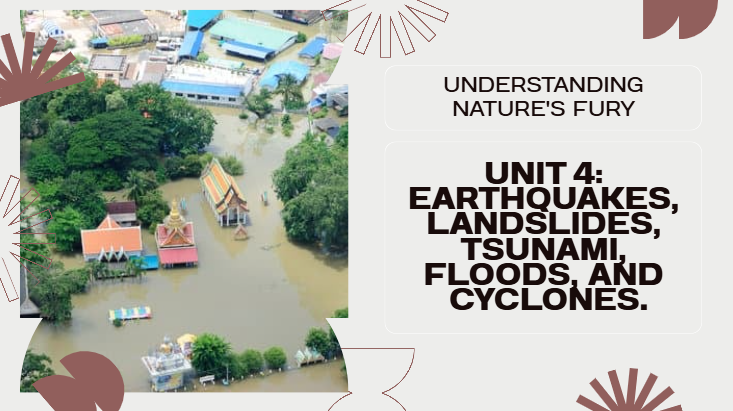
PHYSICS S6 UNIT 4: EARTHQUAKES, LANDSLIDES, TSUNAMI, FLOODS, AND CYCLONES.

About Course
The course Unit 4: Earthquakes, Landslides, Tsunami, Floods, and Cyclones is typically found in curricula focusing on Disaster Management, Environmental Science, or Geography. It provides a comprehensive study of major natural hazards, covering their scientific causes, geographical distribution, impact on human society, and strategies for mitigation and preparedness.
I. Geological Hazards
This section focuses on hazards originating from the Earth’s interior and crust.
1. Earthquakes
-
Causes: You will study plate tectonics, fault lines, elastic rebound theory, and seismic waves (P-waves, S-waves, and surface waves).
-
Measurement: You’ll learn about the Richter scale (magnitude based on wave amplitude) and the Mercalli intensity scale (based on observed effects).
-
Impact: Structural damage, ground shaking, and liquefaction.
2. Landslides
-
Causes: You will analyze the role of gravity, saturation by heavy rainfall, seismic activity, and slope destabilization due to human activities (deforestation, construction).
-
Types: Understanding different types, such as falls, slides, and flows.
3. Tsunami
-
Causes: The primary cause is sudden vertical displacement of the seafloor, most commonly due to large subduction zone earthquakes. Other causes include volcanic eruptions and major landslides.
-
Characteristics: You will study how tsunami waves behave in the deep ocean (long wavelength, small amplitude) versus coastal waters (short wavelength, large amplitude).
-
Early Warning Systems: The technology used to detect and predict tsunami arrival times.
II. Hydro-meteorological Hazards
This section focuses on hazards driven by atmospheric and hydrological processes.
1. Floods
-
Causes: You’ll study the factors leading to different types of floods:
-
Flash Floods: Rapid onset due to intense rainfall or dam failure.
-
Riverine (or Fluvial) Floods: Long-duration flooding due to prolonged rainfall or snowmelt that exceeds the river channel’s capacity.
-
Coastal Floods: Caused by storm surges from cyclones or high tides.
-
-
Mitigation: The role of dams, levees, watershed management, and zoning laws.
2. Cyclones (Hurricanes, Typhoons)
-
Formation and Structure: You will study the conditions necessary for tropical cyclone formation (warm sea surface temperatures, low wind shear), their structure (eye, eyewall, spiral rainbands), and their categorization (e.g., Saffir-Simpson scale).
-
Impacts: The three main destructive effects: high winds, heavy rainfall, and storm surge (abnormal rise in sea level).
III. Disaster Management Principles
The final component integrates the scientific understanding of hazards into practical action:
-
Risk Assessment: Analyzing the likelihood of a hazard and the vulnerability of a community.
-
Preparedness: Planning evacuation routes, building codes, and early warning systems.
-
Mitigation: Long-term measures to reduce risk (e.g., engineering structures, policy changes).
-
Response and Recovery: The immediate and long-term actions taken after a disaster event.
Course Content
THE EARTHQUAKE
-
Origin of earthquakes
16:33 -
Intensity of Earthquakes
18:12 -
Measurement of the Size of Earthquakes
17:06 -
Types of Earthquake Waves
11:57 -
Causes of earthquake
13:51 -
Effects of Earthquakes
16:04 -
Safety Measures on Earthquakes
15:34 -
Checking my Progress
54:48
LANDSLIDES
TSUNAMI
FLOODS
CYCLONES AND ANTICYCLONES
END OF UNIT ASSESSMENT
GENERAL TEST UNIT, PASS MARK OF 80%
Student Ratings & Reviews