PHYSICS S5 Unit 14: Stellar Distance and Radiation.

About Course
The course Unit 14: Stellar Distance and Radiation is an advanced unit in Astrophysics and Astronomy that focuses on the two primary ways astronomers measure and understand stars: determining their vast distances from Earth and analyzing the radiation (light) they emit to deduce their physical properties.
- Measuring Stellar Distance
You will learn the observational techniques used to measure the enormous distances to celestial objects, a core challenge in astronomy.
- Parallax: You will study the trigonometric parallax method, the most direct way to measure the distance to nearby stars.
- Mechanism: This involves observing the apparent shift in a star’s position against the background of more distant stars as the Earth orbits the Sun.
- Units: You will learn and apply the relationship between the parallax angle (θ) and the distance (d) measured in the specialized astronomical unit, the parsec (pc).
- Standard Candles (Conceptual): You will be introduced to the concept of Standard Candles—objects with a known intrinsic brightness (luminosity)—used to measure greater distances beyond the limit of parallax. Examples include Cepheid variable stars and Type Ia Supernovae.
- Inverse Square Law: The principle that allows distance to be calculated once luminosity is known: B α 1/d2 (Brightness decreases with the square of the distance).
- Stellar Radiation and Properties
This section focuses on analyzing the light stars emit to understand their internal physics and surface conditions.
- Blackbody Radiation: You will study the star as an idealized blackbody radiator and apply the laws governing its radiation output:
- Wien’s Displacement Law: Relates the star’s surface temperature (T) to the wavelength at which it emits the maximum amount of radiation (λmax):
λmax α 1/T
This law links a star’s color to its temperature (hot stars are blue/white, cool stars are red).
-
- Stefan-Boltzmann Law: Relates the star’s total luminosity (L) to its temperature (T) and surface area (A) (radius R):
L = AσT4 = 4πR2σT4
This law is essential for determining a star’s radius.
- Spectroscopy: You will learn that analyzing the absorption and emission lines in a star’s spectrum reveals its:
- Chemical Composition: Identifying the elements present in the star’s outer layers.
- Radial Velocity: Measuring the Doppler shift of spectral lines to determine if the star is moving toward us (blueshift) or away from us (redshift).
III. Stellar Classification
The unit culminates in organizing the observational data on a stellar chart.
- Hertzsprung-Russell (H-R) Diagram: You will study the H-R Diagram
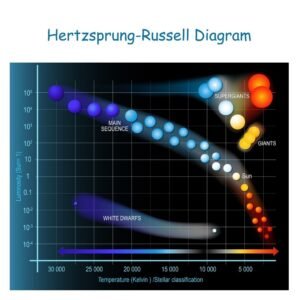
, the most important tool in stellar astrophysics, which plots luminosity (or absolute magnitude) against surface temperature (or spectral class).
Key Regions: You’ll identify the main sequence (where most stars reside), giants, supergiants, and white dwarfs.
Evolution: Understanding where a star is located on the H-R Diagram is key to deducing its age and future evolutionary path.
Course Content
UNIT 14: STELLAR DISTANCE AND RADIATION
-
Introduction
07:31 -
Sun’s atmosphere and interior
22:49 -
Brightness and magnitude scale of stars
24:52 -
Star temperature, colour and spectra
20:37 -
Types of stars and spectra of stars
18:14 -
TEST
07:43
GENERAL TEST
Student Ratings & Reviews