PHYSICS S4 Unit 1: Thin Lenses


About Course
The unit “Unit 1: Thin Lenses” is a foundational course in Geometric Optics. You will learn how simple lenses refract light to form images, focusing on both mathematical calculations and graphical representations.
Core Learning Objectives
1. Fundamentals of Lenses and Light
You will learn the difference between the two main types of thin lenses and key vocabulary.
- Definition of a Thin Lens: Understanding the approximation that the lens thickness is negligible.
- Converging Lenses (Convex):
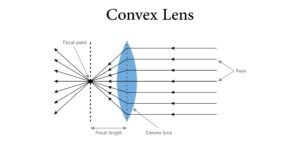
How they cause parallel light rays to converge at a real focal point (). You will know they have a positive focal length ().
- Diverging Lenses (Concave): How they cause parallel light rays to diverge, making them appear to originate from a virtual focal point. You will know they have a negative focal length ().
- Refraction: Reviewing how light bends according to Snell’s Law as it passes from air into the lens material and back out.
2. Image Formation Methods
You will master the two ways to analyze image formation.
- Ray Diagrams: You will learn to draw the three principal rays for both converging and diverging lenses to graphically locate the image. This method helps visualize the characteristics of the image.
- Image Characteristics: You will be able to determine if the image is:
- Real (can be projected) or Virtual (cannot be projected).
- Upright or Inverted.
- Enlarged (magnified) or Reduced (smaller).3. Quantitative Analysis (The Equations)
You will use algebraic equations to precisely calculate the properties of the image.
- The Thin Lens Equation: This is the most important formula, relating the focal length (f), object distance (do), and image distance (di):
1/f = 1/do + 1/di
- Magnification (M): You will use the magnification formula to find the size and orientation of the image:
M = hi/ho = – di/do
Where hi and ho are the image and object heights.
- Sign Conventions: A critical part of the unit is learning and correctly applying the Cartesian sign conventions (e.g., negative di means a virtual image; positive f means a converging lens). Errors in signs lead to incorrect results.
- Lens Power: Understanding the concept of Optical Power (P) in Diopters (D = 1/f).
By the end of this unit, you’ll be able to precisely predict and describe the image formed by any single thin lens, laying the groundwork for understanding the complex optical systems found in cameras, telescopes, and the human eye.
Course Content
Unit 1: Thin Lenses
-
Introduction
11:38 -
Types of Lenses and Their Characteristics
18:57 -
Terms Used in Lenses
08:52 -
Ray Diagrams and Properties of Images Formed by Lenses
25:56 -
The Thin Lens Formula
16:47 -
TEST I
07:15 -
Magnification
13:49 -
Combination of Lenses
18:14 -
Refraction Through Prisms
17:35 -
Dispersion of Light by a Prism
21:42 -
End Of Unit Assessment
45:58 -
TEST II
08:03 -
GENERAL TEST COVERING THIS UNIT, PASS MARK 80%
11:10
Student Ratings & Reviews