PHYSICS S4 Unit 3: Moments and Equilibrium of Bodies

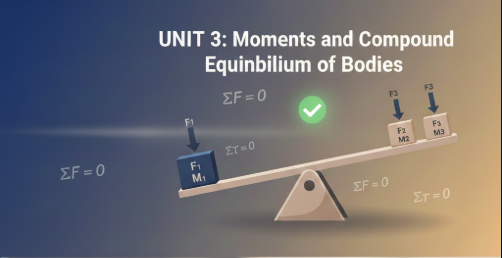
About Course
The unit “Unit 3: Moments and Equilibrium of Bodies” is a fundamental part of Mechanics, specifically focusing on the causes of rotational motion and the conditions under which objects remain stable (equilibrium).
You will transition from dealing purely with linear forces to incorporating the effect of forces applied at a distance, known as moments or torques.
Core Learning Objectives
1. Forces and Resultants (Review/Foundation)
- Revision of Forces: Reaffirming the understanding of force as a vector quantity, including its magnitude and direction.
- Resultant Force: Calculating the single vector that represents the sum of all forces acting on an object. This is a prerequisite for the first condition of equilibrium.
2. The Concept of Moments (Torque)
- Definition of a Moment: Learning that a Moment (or Torque, τ) is the turning effect of a force. It is the product of the force (F) and the perpendicular distance (d) from the pivot point to the line of action of the force.
τ = F * d
- Pivot Point (Fulcrum): Understanding the role of the axis of rotation or pivot point, as the moment depends entirely on this reference point.
- Direction of Moment: Learning the convention for moments: typically, clockwise moments are treated as negative, and anti-clockwise moments are treated as positive.
3. Conditions for Equilibrium
This is the central theme of the unit—analyzing objects that are stable and not moving (static equilibrium) or moving at a constant velocity (dynamic equilibrium).
- First Condition of Equilibrium (Translational Equilibrium): The sum of all forces acting on the body must be zero. This prevents linear acceleration.
∑F = 0
- This is often broken down into components: ∑ Fx = 0 and ∑ Fy = 0.
- Second Condition of Equilibrium (Rotational Equilibrium): The sum of all moments (torques) about any point must be zero. This prevents angular acceleration (rotation).
∑ τ = 0
4. Applications of Equilibrium
You will apply the two conditions of equilibrium to solve problems involving real-world structures.
- Center of Gravity (CG): Understanding the concept that all the weight of an object can be considered to act at a single point called the Center of Gravity. This is crucial for solving problems involving extended bodies.
- Principle of Moments: Applying the second condition to solve problems involving balances, levers, and seesaws.
- Extended Body Problems: Calculating the unknown forces (like tension in cables, reaction forces at supports, or muscle forces) required to keep complex structures (e.g., beams, ladders, bridges) in stable equilibrium.
- Stability: Analyzing the factors that affect the stability of an object, such as the position of its Center of Gravity and the size of its base area.
By the end of this unit, you will be able to perform a complete force and torque analysis on anybody in equilibrium, predicting the forces necessary for stability.
Example: Uniform Beam in Equilibrium
Let’s consider a practical problem that requires applying both conditions of equilibrium.
The Setup
Imagine a uniform beam of mass M and length L. It is supported by two vertical forces, R1 and R2, at either end. A load of mass m is placed a distance x from the support R1.
Goal: Find the Support Forces (R1 and R2)
We want to find the magnitude of the upward reaction forces, R1 and R2, exerted by the supports.
1. First Condition of Equilibrium (Translational)
Since the beam is not accelerating vertically, the sum of all upward forces must equal the sum of all downward forces.
- Upward Forces: R1 + R2
- Downward Forces: Weight of the beam (Wbeam = Mg) + Weight of the load (Wload = mg)
Fy = 0 → R1 + R2 = Mg + mg (Equation 1)
This equation has two unknowns (R1 and R2), so we need another equation.
2. Second Condition of Equilibrium (Rotational)
Since the beam is not rotating, the sum of clockwise moments must equal the sum of anti-clockwise moments about any chosen pivot point. To simplify the problem, we strategically choose a pivot point that eliminates one of the unknowns.
Let’s choose the pivot point at support R1. (This eliminates the unknown R1 from the moment calculation).
- Anti-Clockwise Moments (τACW): Only force R2 causes an anti-clockwise turn about R1.
- Moment due to R2 = R2 * L
- Clockwise Moments (τCW): The beam’s weight and the load’s weight cause clockwise turns about R1.
- Moment due to beam’s weight (Mg) = Mg * (L/2) (since the beam is uniform, its weight acts at the center, L/2).
- Moment due to load’s weight (mg) = mg * x
∑τACW = ∑τCW
R2 * L = (Mg *L/2) + (mg * x) (Equation 2)
3. Solving the System
From Equation 2, we can easily solve for R2:
R2 = (Mg * L/2 + mg * X)/L
R2 = Mg/2 + (mg * X)/L
Once R2 is known, we substitute it back into Equation 1 to find R1:
R1 = Mg + mg – R2
This two-step process—using the translational equilibrium equation and then the rotational equilibrium equation (by choosing a strategic pivot)—is the key method for solving most problems in this unit.
Course Content
Unit 3 Moments and Equilibrium of Bodies
-
Scalar and Vector Quantities
18:44 -
Turning Effect of Force
16:58 -
Equilibrium of a Body
13:15 -
Centre of Gravity and Center of Mass
19:14 -
TEST I
07:11 -
TEST II
06:08 -
End of Unit Assessment
46:14 -
GENERAL TEST COVERING THIS UNIT, PASS MARK 80%.
06:04
Student Ratings & Reviews