PHYSICS S4 Unit 2: Simple and Compound Optical Instruments

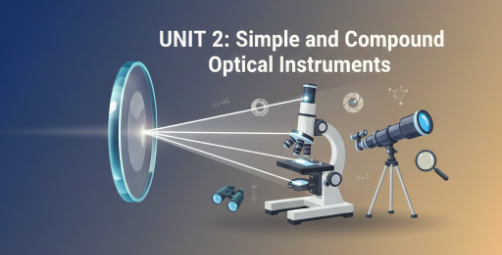
About Course

The unit “Unit 2: Simple and Compound Optical Instruments” is where you apply the principles of refraction and image formation (learned in Unit 1: Thin Lenses) to understand how various real-world devices function.

You will transition from analyzing single-lens systems to understanding the complex, multi-lens configurations of instruments used for both distant and close observation.

Core Learning Objectives

1. Simple Optical Instruments

You will focus on single-lens systems and their quantitative measures.

  • The Simple Magnifier (Magnifying Glass):
    • Principle: Using a single convex lens to form a magnified, virtual, and upright image.
    • Image Formation: Understanding how the object must be placed within the focal length (do < f).
    • Angular Magnification: Calculating the effectiveness of the magnifier, typically when the final image is formed at the least distance of distinct vision (D ≈ 25cm):

M = 1 + D/f

2. Compound Optical Instruments

This section covers instruments that use two or more lenses to achieve greater magnification and resolution. You will analyze the role of each lens in the system.

  • The Compound Microscope:

Understanding the function of the two main lenses: The Objective Lens (short focal length) and the Eyepiece Lens (acting as a simple magnifier).

  • Image Formation:
  1. The objective forms a (real, inverted, and magnified) intermediate image.
  2. The eyepiece magnifies this intermediate image to form the (final, virtual, inverted, and highly magnified) image.

 Total Magnification: Calculating the total magnification as the product of the magnification of the two lenses (Mtotal = Mobj* Meye).

  • The Telescope (Refracting):
    • Structure: Understanding the function of the Objective Lens (large aperture and long focal length to gather light) and the Eyepiece Lens (short focal length).
    • Image Formation:
      1. The objective forms a real, inverted, and reduced intermediate image near its focal point.
      2. The eyepiece magnifies this image to produce the final, virtual, inverted, and magnified image of the distant object.
    • Angular Magnification: The key metric for a telescope is the ratio of the focal lengths:

M ≈ – fobjective/feyepiece

3. Other Essential Optical Devices

You will also study the optics of everyday and specialized instruments:

  • The Human Eye: Understanding the eye as a natural optical instrument, including its parts (cornea, lens, retina) and how it focuses light.
  • Vision Defects and Correction: Learning about common vision problems like Myopia (nearsightedness, corrected with diverging/concave lenses) and Hypermetropia (farsightedness, corrected with converging/convex lenses).
  • The Camera: Understanding the basic mechanism of a lens camera, which focuses light onto a film or sensor to form a real, inverted

By the end of this unit, you will not only be able to draw ray diagrams for these instruments but also use the thin lens equation and magnification formulas repeatedly to calculate the specific characteristics and performance of each device.

Show More

What Will You Learn?

  • The unit "Unit 2: Simple and Compound Optical Instruments" will take the fundamental principles of thin lenses you learned in Unit 1 (image formation, magnification, and the lens equation) and apply them to understand the workings of various devices we use to enhance or correct vision.
  • Here is a breakdown of the core topics you will master:
  • The Human Eye and Vision Correction
  • You will start by treating the human eye as a natural optical instrument.
  • • Physical Features: Identifying the key parts of the eye, such as the cornea, crystalline lens, iris, ciliary muscles, and retina.
  • • Image Formation: Understanding how the eye's lens system and cornea refract light to form a real, inverted, and reduced image on the retina.
  • • Accommodation: Learning how the ciliary muscles change the thickness (and thus the focal length/power) of the lens to focus on objects at different distances.
  • • Vision Defects: Analyzing common vision problems:
  • o Myopia (Nearsightedness): Corrected using diverging (concave) lenses to push the focal point back onto the retina.
  • o Hypermetropia (Farsightedness): Corrected using converging (convex) lenses to pull the focal point forward onto the retina.
  • • Calculating Corrective Lens Power: Applying the thin lens equation and the concept of optical power (Diopters) to determine the exact lens needed to correct a defect, based on the patient's near and far points.
  • Simple Optical Instruments
  • These are devices that typically use a single lens or a single primary lens system.
  • • The Simple Microscope (Magnifying Glass):
  • o Principle: Using a convex lens with a short focal length to form a virtual, upright, and magnified image.
  • o Angular Magnification (M): Understanding that its effectiveness is measured by the ratio of the angle subtended by the image to the angle subtended by the object when placed at the near point (D ≈ 25cm).
  • o Formulas: Calculating magnification when the final image is formed at the near point (M = 1 + D/f) and when it is formed at infinity (D/f).
  • Compound Optical Instruments
  • These instruments use multiple lenses arranged sequentially to achieve high magnification or view distant objects. You will analyze them as a two-stage process.
  • 1. The Compound Microscope
  • • Purpose: To achieve very high magnification of very small, nearby objects (e.g., cells).
  • • Structure: Understanding the roles of the two main lenses:
  • o Objective Lens: Has a very short focal length (fo). It forms a large, real, and inverted intermediate image.
  • o Eyepiece Lens: Has a short focal length (fe). It acts as a simple magnifier for the intermediate image.
  • • Total Magnification: Calculating the overall magnification, which is the product of the magnification of the objective (Mo) and the eyepiece (Me): Mtotal = Mo* Me.
  • 2. The Refracting Telescope:
  • • Purpose: To magnify distant objects (e.g., stars, planets).
  • • Structure:
  • o Objective Lens: Has a very long focal length (fo). It gathers light and forms a real, inverted, and reduced intermediate image at its focal point.
  • o Eyepiece Lens: Has a short focal length (fe). It magnifies the intermediate image.
  • • Angular Magnification: Understanding that for distant objects, the key measure is angular magnification, calculated by the ratio of the focal lengths:
  • M ≈ fo/fe
  • Other Applications
  • The unit may also cover the basic optical principles of devices like:
  • • The Camera: Understanding how a lens focuses a real, inverted, and reduced image onto a sensor or film.
  • • Slide Projectors: Understanding how a converging lens system projects an inverted, magnified, and real image onto a distant screen.
  • By the end of this unit, you will be able to analyze and calculate the performance metrics (magnification, image distance, etc.) for the most common and essential optical devices.

Course Content

Unit 2: Simple and Compound Optical Instruments

  • Definition of an Optical Instrument
    05:36
  • Defects of Vision and Their Correction
    15:34
  • A lens Camera
    12:26
  • The Slide Projector
    22:16
  • TEST I
    07:14
  • Microscope
    18:57
  • Telescopes
    24:33
  • Reflecting Telescopes
    19:49
  • TEST II
    07:08
  • End Of Unit Assessment
    48:51
  • GENERAL TEST , PAST MARK 80%
    11:14

Student Ratings & Reviews

No Review Yet
No Review Yet

Want to receive push notifications for all major on-site activities?