PHYSICS S5 UNIT 10: Analog and Digital Signals

By Mukongori
Categories: S5 PHYSICS
About Course
The course Unit 10: Analog and Digital Signals is a fundamental unit in Electronics, Telecommunications, and Computer Science. It covers the nature, characteristics, and practical differences between the two primary forms of electronic communication and data representation.
- Analog Signals
This section focuses on continuous, real-world signals.
- Definition: An analog signal is a continuous wave (usually sinusoidal) that represents physical phenomena (like sound, temperature, or light) by continuously varying its amplitude or frequency over time.
- Characteristics:
- Continuous: The signal can take on any value within a given range at any point in time.
- Examples: Human voice, radio waves, light intensity, and the output of a traditional microphone.
- Drawbacks: Analog signals are susceptible to noise (unwanted electrical fluctuations). Since the signal and noise are both continuous, it is difficult to separate them, leading to signal degradation over distance or processing.
- Transmission: Uses modulation techniques like Amplitude Modulation (AM) or Frequency Modulation (FM).
- Digital Signals
This section focuses on discrete signals used in modern computing.
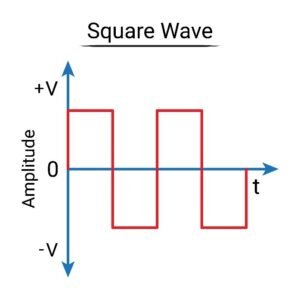
- Definition: A digital signal is a discrete, time-quantized signal that represents data as a sequence of binary values, typically just two levels: HIGH (1) and LOW (0).
- Characteristics:
- Discrete: The signal can only take on a finite number of values (usually two) at specific intervals.
- Representation: Data is represented in binary code.
- Examples: Data stored on a computer, Wi-Fi signals, and data transmitted over fiber optics.
- Advantages:
- Noise Immunity: Digital signals are highly immune to noise. Since the signal is only checked for being a ‘1’ (above a certain threshold) or a ‘0’ (below a certain threshold), small noise fluctuations don’t affect the data’s integrity.
- Data Storage: Easy and accurate to store, retrieve, and process using computer logic.
- Transmission: Uses encoding techniques to represent binary data as voltage or light pulses.
III. Conversion and Applications
You will learn how to bridge the gap between the analog world and the digital technology used to process it.
- Analog-to-Digital Conversion (ADC): The process of converting a continuous analog signal into a discrete digital representation. This is crucial for devices like cell phones and computers to record real-world sound or images.
- Key steps include sampling (checking the analog value at regular intervals) and quantization (rounding the sampled value to the nearest digital code).
- Digital-to-Analog Conversion (DAC): The process of converting a digital signal back into an analog signal (e.g., converting a digital music file into the continuous electrical signal needed to drive a speaker).
- Applications: You will compare and contrast the use of analog and digital signals in various applications:
- Communication: Digital signals dominate (cellular networks, internet).
- Recording: Digital recording provides superior fidelity and durability.
- Measurement: Many sensors are analog, requiring ADC for computer processing.
This unit provides the foundational knowledge for understanding how information is coded, transmitted, and interpreted in virtually all modern electronic devices.
Course Content
UNIT 10: ANALOG AND DIGITAL SIGNALS
-
Introduction
08:11 -
Information transmission in a communication system
15:16 -
Communication Terms and Concepts
17:08 -
Elements of communication
14:59 -
Types of information and requirements
13:48 -
Simplex transmission
17:31 -
Half-duplex communications
15:10 -
Full-duplex communications
19:24 -
TEST I
02:00:00 -
Bandwidth and signal Frequency
18:18 -
Analog signal system
19:23 -
Analog signals
15:59 -
Advantages and disadvantages of analog signals
16:03 -
Digital signals
18:26 -
Advantages of digital technology
14:51 -
Comparing digital and analog signals
11:58 -
Logic gates
14:15:56 -
TEST II
02:00:00 -
GENERAL TEST, PASS MARK 80%
11:10
Student Ratings & Reviews

No Review Yet