PHYSICS S5 Unit 5: Complex Electrical Circuit


About Course
The unit “Unit 5: Complex Electrical Circuits” focuses on analyzing circuits that cannot be solved simply by reducing them to basic series and parallel combinations.
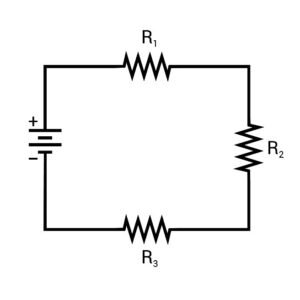
These circuits often contain multiple power sources and intricate series-parallel arrangements of components.
The main goal of this unit is to master the advanced theorems and techniques required to systematically determine the voltage and current for every component in such networks.
Key Concepts
- Complex Circuits: Circuits that require systematic methods (Nodal or Mesh Analysis) or +network theorems for solution because they contain more than one source and/or a non-trivial combination of components.
- Kirchhoff’s Laws: These are the foundational tools for all complex circuit analysis:
- Kirchhoff’s Current Law (KCL): The algebraic sum of currents entering a node (junction) is zero (∑ Iin = ∑ Iout). This represents the conservation of charge.
- Kirchhoff’s Voltage Law (KVL): The algebraic sum of all potential differences (voltages) around any closed loop is zero (∑V = 0). This represents the conservation of energy.
Circuit Analysis Techniques
These are the systematic methods used to set up and solve systems of simultaneous equations for a complex circuit:
|
Method |
Principle Used |
Unknown Variables Solved |
Best Application |
|
Nodal Analysis |
KCL at each independent node. |
Node Voltages |
Circuits with more branches connected to nodes than meshes, especially with current sources. |
|
Mesh Analysis |
KVL around each independent closed loop (mesh). |
Mesh Currents |
Planar circuits with fewer meshes than nodes, especially with voltage sources. |
Network Theorems (Simplification Tools)
These theorems allow complex circuits to be simplified or analyzed under specific conditions:
- Superposition Theorem: Used in circuits with multiple independent sources. It states that the total response (current or voltage) is the sum of the responses caused by each source acting individually, while all other sources are temporarily “turned off” (voltage sources replaced by shorts, current sources replaced by opens).
- Thévenin’s Theorem: Replaces a complex linear two-terminal network with a single voltage source (Vth) in series with a single resistor (Rth). This is ideal for analyzing the effect of different loads attached to the network.
- Norton’s Theorem: Replaces a complex linear two-terminal network with a single current source (In) in parallel with a single resistor (Rn).
- Maximum Power Transfer Theorem: States that a source delivers maximum power to a load when the load resistance (RL) is equal to the source’s equivalent (Thévenin) resistance (Rth).
Course Content
UNIT 5: COMPLEX ELECTRICAL CIRCUIT.
-
Introduction.
10:12 -
Kirchhoff’s laws
15:16 -
Design of complex and simple electric circuits
21:25 -
Resistors and electromotive forces in series and parallel complex circuits
24:34 -
Simple potentiometer circuits
14:58 -
Measurement of current by potentiometer
16:57 -
Advantages and disadvantages of potentiometer
13:54 -
TEST
01:30:00
GENERAL TEST
Student Ratings & Reviews