PHYSICS S5 UNIT 9: Atomic Models and Photoelectric Effect

By Mukongori
Categories: S5 PHYSICS
About Course
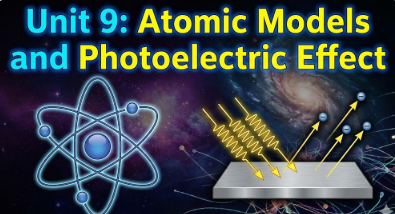
The course Unit 9: Atomic Models and Photoelectric Effect is a pivotal unit in Modern Physics that marks the transition from classical physics to quantum mechanics. It explores the evolution of humanity’s understanding of the atom and the experimental evidence that established the dual wave-particle nature of light.
I. Atomic Models: The Evolution of Structure
You will study the historical development of atomic theory, understanding why each model was replaced by a more refined one:
- Thomson’s Plum Pudding Model: The earliest model proposing that the atom was a positively charged sphere with negatively charged electrons embedded in it, like plums in a pudding.
- Rutherford’s Planetary Model (The Gold Foil Experiment): You will analyze the famous Rutherford scattering experiment, which showed that most of the atom is empty space and that nearly all the mass is concentrated in a tiny, dense, positively charged center called the nucleus. This disproved the Plum Pudding Model.
- Bohr’s Model (Quantization): This model was a crucial stepping stone into quantum theory. You will study its postulates:
- Electrons orbit the nucleus in specific, stable orbits (stationary states) without radiating energy.
- The angular momentum of the electron is quantized (L = nh/2π).
- Electrons only change energy when they jump between these orbits, absorbing or emitting a photon whose energy is equal to the difference between the energy levels: Ephoton = Ei – Ef.
- Spectral Series: You will apply the Bohr model to explain the discrete line spectra of hydrogen (Lyman, Balmer, Paschen series), demonstrating the quantization of energy levels.
II. The Photoelectric Effect
This experimental phenomenon provides the definitive proof that light behaves as a particle (photon).
- Experimental Setup: You will study the key observation that when light shines on a metal surface, electrons (photoelectrons) are ejected.
- Classical Failure: You will learn why classical wave theory failed to explain the observations:
- Classical theory predicted that the energy of the electron should depend on the light’s intensity, but experiments showed it depended on the light’s frequency.
- Classical theory predicted a time delay before electron emission, but experiments showed instantaneous emission (if the frequency was high enough).
- Einstein’s Quantum Explanation: You will analyze Albert Einstein’s theory (for which he won the Nobel Prize), which proposed that light is made of discrete energy packets called photons.
- The energy of a single photon is directly proportional to its frequency (ʋ): E = hʋ, where h is Planck’s constant.
- The Photoelectric Equation: This core equation describes the energy balance of the interaction:
hʋ = ϕ + Ek,max
Where:
-
- hʋ is the energy of the incident photon.
- ϕ is the work function (the minimum energy required to eject an electron from the metal surface).
- Ek,max is the maximum kinetic energy of the emitted electron.
- Threshold Frequency (ʋ0): You will learn that electrons are only emitted if the light’s frequency is above a certain minimum value (ʋ0), where hʋ0 = ϕ.
This unit is essential for understanding the foundations of quantum mechanics, establishing the dual nature of light (both wave and particle).
Course Content
UNIT 9: ATOMIC MODELS AND PHOTOELECTRIC EFFECT
-
Introduction
12:15 -
Structure of atom
14:30 -
Rutherford’s atomic model
16:45 -
Bohr’s atomic model
17:08 -
Energy levels and spectral lines of Hydrogen
22:15 -
Thermionic emission (thermo electronic emission)
16:48 -
Applications of cathode rays
19:17 -
Fluorescence and phosphorescence
21:14 -
Photoelectric emission laws’
16:57 -
Photoelectric effect
23:52 -
TEST I: My Progress
07:11 -
Factors affecting photoelectric emission
18:53 -
Photon, work function and Plank constant
19:19 -
Einstein’s equation photoelectric effect
14:59 -
Application of photoelectric effect (photo emissive and photovoltaic cells)
16:27 -
Compton effect
15:41 -
TEST II: My Progress
06:14 -
GENARAL TEST, PASS MARK 80%
06:58
Student Ratings & Reviews

No Review Yet