PHYSICS S6 UNIT 9: PROPERTIES AND BASIC PRINCIPLES OF QUARKS

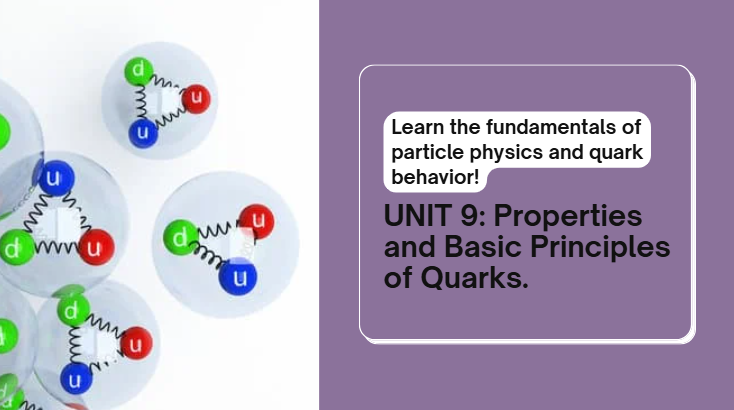
About Course
The course Unit 9: Properties and Basic Principles of Quarks is an advanced topic typically found in particle physics, nuclear physics, or quantum field theory curricula. It dives into the fundamental building blocks of matter, specifically the subatomic particles known as quarks, and the strong nuclear force that binds them.
I. The Standard Model Context
The unit begins by placing quarks within the framework of the Standard Model of Particle Physics, the most successful theory describing the fundamental particles and forces of nature.
- Fermions: Quarks belong to the group of fundamental particles called fermions (which have half-integer spin, ħ/2). They are categorized as matter particles.
- Fundamental Particles: You’ll learn that quarks (along with leptons, such as the electron and neutrino) are considered truly fundamental, meaning they have no known internal structure.
II. Properties of Quarks
The core of the unit is understanding the specific characteristics of these particles:
- Six “Flavors”: There are six types, or flavors, of quarks: up (u), down (d), strange (s), charm (c), top (t), and bottom (b).
- Electric Charge: Quarks have fractional electric charges, unlike protons or electrons, which have integer charges (±1).
- Up, Charm, Top Quarks: Charge of +2/3
- Down, Strange, Bottom Quarks: Charge of -1/3
- Baryon Number: Quarks have a baryon number of 1/3, which explains why combinations of three quarks (baryons) have an integer baryon number of 1.
III. Basic Principles and Color Charge
This section introduces the unique principle that governs how quarks interact via the strong nuclear force.
1. Color Charge
- Analogy to Electric Charge: Just as electric charge governs electromagnetic interactions; color charge governs the strong interaction.
- Three “Colors”: Quarks come in three types of color charge (arbitrarily called red, green, and blue).
- Antiquarks: Antiquarks have anti-colors (anti-red, anti-green, anti-blue).
- Conservation: Color charge must be conserved in interactions.
-
Quantum Chromodynamics (QCD)
- QCD is the theory describing the strong interaction between quarks and gluons (the force carriers).
- Gluons: Gluons carry both a color and an anti-color charge, allowing them to mediate the strong force and change the color of the quarks they interact with.
-
Confinement
- The Key Principle: This is the most important concept: Quarks cannot exist in isolation; they are always confined in groups.
- Mechanism: The strong force does not decrease with distance like the electromagnetic force (1/r2). Instead, the force increases with distance. If you try to pull two quarks apart, the force binding them remains constant (like stretching a rubber band). Eventually, enough energy is put into the field to create a new quark-antiquark pair instead of separating the original pair.
IV. Hadron Formation
You will learn how quarks combine into composite particles called hadrons:
- Baryons: Composed of three quarks (e.g., uud is a proton, udd is a neutron). The three quarks must combine to form a “colorless” (white) state (red + green + blue).
- Mesons: Composed of a quark and an antiquark (e.g., a pion). The quark and antiquark combine to form a “colorless” state (color + anti-color).
Course Content
INTRODUCTION
-
Introduction
11:23
TYPES OF QUARKS
BARYON NUMBER, LEPTON NUMBER AND THEIR LAWS OF CONSERVATION
SPIN STRUCTURES OF HADRONS (HADRONS AND MESONS)
COLOR IN FORMING OF BOUND STATES OF QUARKS
END OF UNIT ASSESSMENT
GENERAL TEST UNIT, PASS MARK 80%
Student Ratings & Reviews