MATHEMATICS S5 UNIT 5: Trigonometric Functions and Their Inverses.

About Course

Trigonometric functions and their inverses are fundamental concepts in mathematics, particularly in pre-calculus, calculus, and their applications in science and engineering. They describe relationships between angles and side lengths of triangles, and extend to represent periodic phenomena.

1. Trigonometric Functions (The Six Basic Functions)

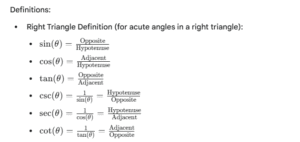
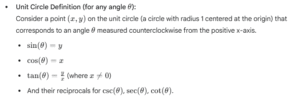
Trigonometric functions are functions of an angle. They are most commonly defined using either the unit circle or right-angled triangles.
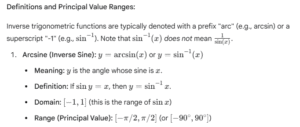
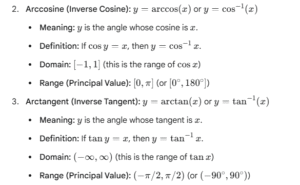
2. Inverse Trigonometric Functions (Arc Functions)

Inverse trigonometric functions are used to find the angle when the value of a trigonometric ratio is known. They “undo” the action of the original trigonometric functions.

The Challenge of Inverses and Domain Restriction:

Standard trigonometric functions are not one-to-one (they fail the horizontal line test) because they are periodic. For an inverse function to exist, the original function must be one-to-one. Therefore, to define inverse trigonometric functions, we must restrict the domain of the original trigonometric functions to an interval where they are one-to-one and cover their full range. This restricted interval is called the principal value range.
 

Show More

What Will You Learn?

  • Precisely define sine, cosine, tangent, cosecant, secant, and cotangent using both the right-angle triangle (SOH CAH TOA) and the unit circle definitions.
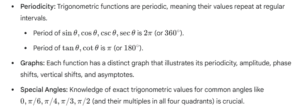
  • Evaluate trigonometric functions for special angles (e.g., 0,π/6,π/4,π/3,π/2, and their multiples) without a calculator, and for other angles using a calculator.
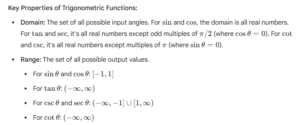
  • Identify and articulate the domain, range, and periodicity for all six trigonometric functions.
  • Recognize and interpret amplitude, phase shift, and vertical shift in transformed trigonometric functions (e.g., y=Asin(Bx−C)+D).
  • Identify and understand the significance of asymptotes for tangent, cotangent, secant, and cosecant functions.
  • Accurately sketch the graphs of the basic sine, cosine, and tangent functions.
  • Graph transformed trigonometric functions, correctly applying concepts of amplitude, period, phase shift, and vertical shift.
  • Interpret information about periodic phenomena from their trigonometric graphs.
  • Apply trigonometric functions to find unknown side lengths or angles in right-angled triangles.
  • Solve real-world problems involving angles of elevation/depression, bearings, and basic surveying.
  • Understand the Need for Inverse Functions: Explain why the domains of trigonometric functions must be restricted to define their inverses (due to their periodic nature).
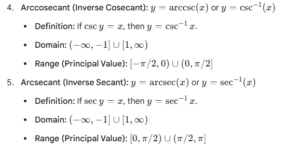
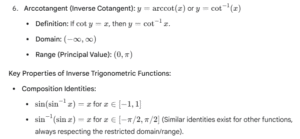
  • Define and State Principal Value Ranges: Accurately define arcsine, arccosine, and arctangent (along with arccosecant, arcsecant, and arccotangent), including their specific principal value ranges.
  • Evaluate exact values of inverse trigonometric functions for common inputs
  • Graph Inverse Trigonometric Functions: Sketch the graphs of the principal branches of arcsine, arccosine, and arctangent, understanding their domain and range.
  • Apply Inverse Functions in Problem Solving: Use inverse trigonometric functions to find angles in various geometric and applied contexts

Course Content

Generalities on Trigonometric Functions and Their Inverses.

  • Domain and Range of Six Trigonometric Functions.
    14:59
  • Domain and Range of Inverses of Trigonometric Functions.
    19:38
  • Party of Trigonometric Functions.
    18:49

Limits of Trigonometric Functions and Their Inverses.

Differentiation of Trigonometric Functions and Their Inverses.

Applications.

Questions and Answers

End of Unit Assessment.

Final Unit Exam

Student Ratings & Reviews

No Review Yet
No Review Yet

Want to receive push notifications for all major on-site activities?